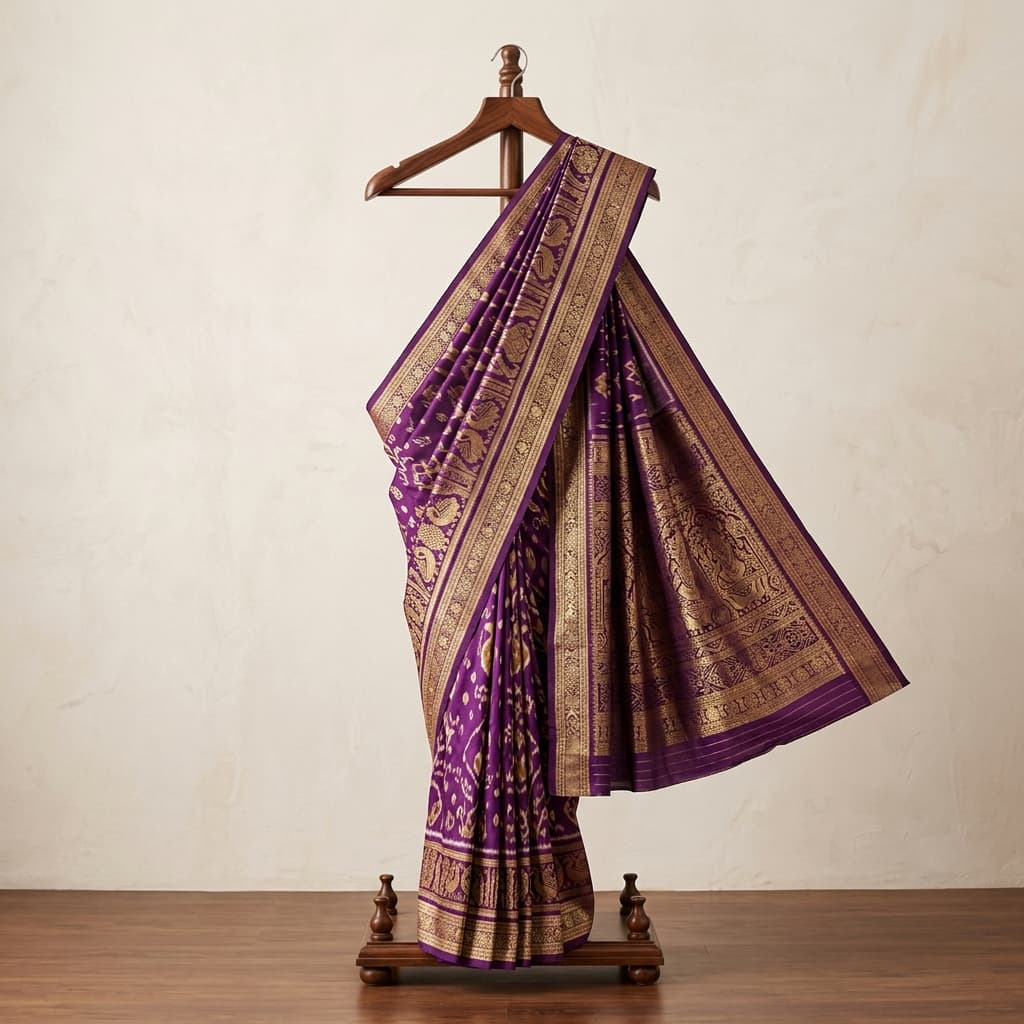
The Ancient Art of Resist-Dyeing
In the weaving clusters of Sonepur and Bargarh in western Odisha, master artisans begin a process that transforms raw silk threads into mathematical masterpieces — Sambalpuri Ikat sarees.
The word "Ikat" comes from the Malay-Indonesian term "mengikat," meaning "to tie." This resist-dyeing technique, perfected over 800 years in Odisha, involves tying individual threads with wax-coated string before dipping them into natural dye baths. The result? Patterns that seem to emerge from within the fabric itself.
Step 1: Thread Preparation (Days 1-5)
The journey begins with selecting the finest mulberry silk threads. Each thread is carefully measured, grouped, and prepared for the tying process. A single saree requires over 4,000 individual threads, each of which must be precisely positioned.
Step 2: Tying & Dyeing (Days 5-20)
This is where the mathematics comes in. The artisan must calculate exactly where each color will appear in the final design — and tie the threads accordingly. Each knot placement determines a pixel in the pattern. After tying, the threads are submerged in natural dyes made from indigo plants, turmeric, and other local botanicals.
Step 3: The Weaving (Days 20-50)
Once dyed, the threads are loaded onto a traditional wooden handloom. The weaver works with both warp and weft threads (in double-Ikat, both sets are pre-dyed), requiring extraordinary precision to align the patterns at every intersection.
Step 4: Finishing & Quality Check (Days 50-60)
The completed saree is inspected, steamed, and finished. Each piece is unique — no two Ikat sarees are exactly alike, owing to the handmade nature of the resist-dyeing and weaving process.
Why This Matters
When you purchase an authentic Sambalpuri Ikat saree from Ambika Handloom, you're not just buying fabric. You're investing in a 45-60 day journey of human skill, mathematical precision, and cultural heritage. You're directly supporting artisan families who have kept this tradition alive for generations.
Every thread tells a story. Every saree is a masterpiece.